Tractor Transmission System Explained: Parts, Types, and Functions
 Published - 30 Oct 2025
by Tractor Junction

 Share
Social Share


If you are planning to buy a tractor, understanding the tractor transmission system is important. The transmission system, or power transmission system, is what delivers power from the engine to the moving parts of the tractor, including the wheels. It directly influences the tractor’s ability to perform different farming tasks by changing its speed, torque, and direction. Therefore, understanding the system and its types is crucial for choosing the right tractor.
This blog explains what is transmission, the key components, and the different types of transmission systems in tractors.
What is Transmission in Tractors?
A tractor’s transmission is a system that provides power from the engine to the wheels. It is usually placed behind the engine and contains gears that help control how the tractor moves. By changing gear ratios, the transmission allows the tractor to run at different speeds.
Its main functions include:
- Changing the speed of the tractor needed for different farming tasks.
- Providing higher torque at lower speeds for heavy fieldwork.
- Allowing forward and reverse movement of the tractor.
The transmission system in tractors is not one or two but an entire network of components. This network is made up of clutch, gearboxes, differential, final drive, and axles.
What are Tractor Transmission Parts?

Let’s explore the main components of the transmission system you’ll find in a tractor and how they function.
Clutch
A clutch in a tractor is a mechanical device that connects and disconnects the engine from the transmission system. It allows the driver to change gears, stop the tractor, or run implements without stopping the engine.
Tractor clutches are classified based on how they control the wheels and how they are lubricated.
- Single Clutch: This clutch features only one clutch plate and one pedal to control the wheels and the PTO shaft of the tractor. have to stop the PTO when you need to change gears or stop the tractor. Therefore, they are mostly used in mini tractors under 35 HP that do not have much use of PTO.
- Dual Clutch: Dual Clutch has two single plates working together, controlled by one 2-stage pedal. When you press the clutch pedal halfway, it stops the tractor’s wheels so you can change gears. When you press it all the way down, it prevents both the wheels and the PTO from turning.
- Double Clutch: The double clutch transmission in tractors may seem similar to a dual clutch, but it comes with two separate clutch systems. The foot pedal is used to control the wheels, and the hand lever is for the PTO. This clutch is more flexible as it can stop the tractor without stopping the implement.
- Dry Clutch: A dry clutch in a tractor works without any fluid or oil. It is simple in design, easy to maintain, and costs less to repair. However, they can wear out faster because there is no oil to keep them cool.
- Wet Clutch: This type of clutch operates in an oil bath. The oil keeps the clutch cool and quiet, making it a good choice for heavy-duty tractors that work for long hours. However, they are more expensive and harder to repair.
Gearbox
Gears in tractors control how power from the engine is used for different agricultural tasks. The primary function of gears in tractors is to maintain their speed and pulling strength (torque). It does so by changing the gear ratio between the engine and the wheels. When the lower gear is selected, the tractor moves slowly but gains more power for heavy work like ploughing or hauling. Higher gears, on the other hand, allow tractors to move faster with less power, which is useful for transport or light fieldwork.
Broadly, tractor gear systems can be classified based on their internal gear design and their overall function.
Based on Internal Gear Design:
- Sliding Mesh Gearbox
- Constant Mesh Gearbox
- Synchromesh Gearbox
Based on their Function:
- Manual Transmission
- Power Shift or Automatic Transmission
- Hydrostatic Transmission
- Continuous Variable Transmission
Most tractors available in India come with a manual transmission.
Differential
The differential helps the rear wheels of the tractor to rotate at different speeds, especially when turning. This is important because the outer wheel has to travel a longer distance than the inner one when a tractor turns. Without a differential, both wheels would be forced to move at the same speed. This could cause slipping, soil damage, and extra strain on the tyres.
Final Drive
The final drive gears reduce the speed of rotation coming from the differential to increase the torque. This ensures that the tractor has enough power to handle heavy implements or steep terrains without putting too much strain on the engine.
Final drives allow tractors to run smoothly at low speeds while performing heavy-duty tasks like ploughing, tilling, or transporting heavy loads. Without a final drive, the tractor may not be able to provide enough torque to handle heavy tasks.
Axles
The axles are strong metal shafts that carry power from the final drive to the tractor’s wheels. They rotate the wheels according to the power supplied. Axles play an important role in maintaining stability and balance when driving the tractor. In addition, they also absorb shocks from bumps and uneven ground.
Tractors use different types of axles based on their design, function, and where they are positioned. Here are the main types of axles used in tractors:
- Front Axle: The front axle is located at the front of the tractor and steers the tractor. In four-wheel-drive models, it also helps transmit power to the front wheels. Front axles maintain balance, particularly when using heavy front implements or loaders.
- Rear Axle: It is the main driving axle in most tractors. It carries the tractor’s weight, transmits power from the transmission system to the rear wheels, and supports the differential and final drive.
- Stub Axle: Stub axle helps in turning the front wheels of the tractor and provides smooth steering control. It helps absorb shocks from bumps and hard soil.
Conclusion
Understanding what is transmission in tractors and how their components function helps farmers choose the right tractor for their farming needs. The right transmission system allows tractors to perform efficiently under different soil conditions. From the clutch and gearbox to the differential, final drive, and axles, every part works together to deliver power efficiently.
FAQs:
What is the function of a tractor transmission system?
The transmission system in tractors transfers power from the engine to the wheels and controls the tractor’s speed and torque.
What are the main parts of tractor transmission systems?
The five main parts of the tractor transmission system are the clutch, gearbox, differential, final drive, and axle.
Do tractors have manual transmissions?
Yes, many tractors available in India have manual transmissions because they provide full control.
Are dual clutch and double clutch the same?
No, dual clutch and double clutch are two different types of clutches.
What are the three types of axles in a tractor transmission system?
Front axle, rear axle, and stub axle are the three types of axles in the tractor transmission system.
Can regular maintenance extend the life of the transmission system?
Yes, timely maintenance and oil checks help prevent wear and improve performance.
Certified Used Tractors
 Book Now


Top News
 November 12, 2026
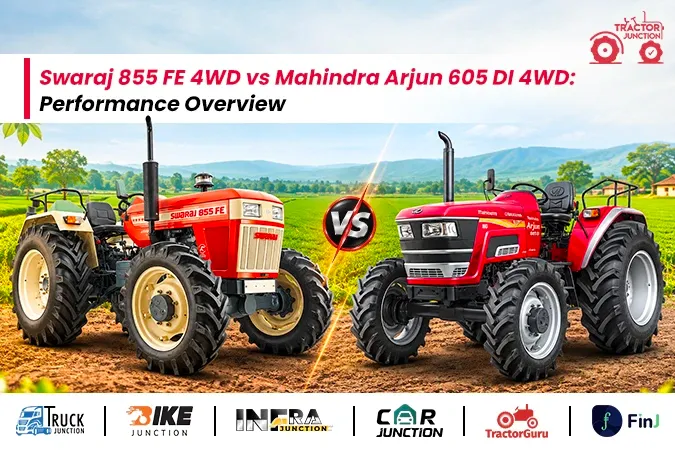
Swaraj 855 FE 4WD and Mahindra Arjun Novo 605 DI-i 4WD are two well known
Read More November 14, 2026
Farming costs keep going up. Diesel, inputs and equipment all cost more every year. For
Read More October 28, 2026
Buying a tractor is an important investment for any farmer. The right tractor should meet
Read More November 01, 2026
Choosing the right tractor is one of the biggest decisions a farmer makes, because the
Read More October 30, 2026
Farming does not wait for machines that break down or feel hard to handle. You
Read More November 25, 2026
खेती के साथ ट्रॉली से सामान ढुलाई के लिए कितना उपयोगी है यह ट्रैक्टर? जानें
Read More November 25, 2026
पेराई सत्र 2026-27 में गन्ना क्रय केंद्रों पर गन्ना एवं बाट-माप विभाग के अधिकारी करेंगे
Read More November 25, 2026
जानें, दोनों ट्रैक्टरों का मॉडल ईयर, कीमत, कंडीशन और ऑनलाइन खरीदने की पूरी जानकारी खेती-किसानी
Read More November 24, 2026
पावरट्रैक के डिजिट्रैक पोर्टफोलियो में अब 45 से 55 HP कैटेगरी के पांच मॉडल शामिल
Read More November 24, 2026
भारतीय बासमती धान की प्रमुख किस्मों के भाव में तेजी, पाकिस्तान के चावल निर्यात में
Read MoreIn Other News