TREM V 2026: Will Tractor Prices Increase in India? New Emission Norms Explained
 Published - 05 Mar 2026
by Tractor Junction

 Share
Social Share


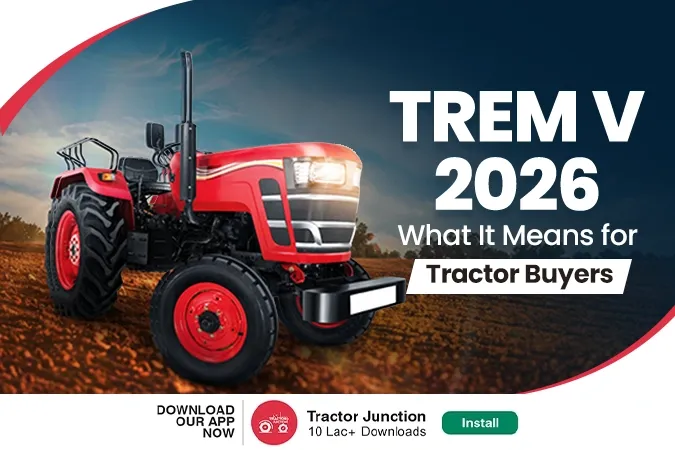
There is a lot of talk in the tractor market about the upcoming TREM V emission norms. Many farmers are asking the same question: Will tractors become more expensive in 2026? Right now, there is a discussion that the government may bring these rules into effect on April 1, 2026. At the same time, tractor companies and farmer groups are asking the government to move slowly.
So what is really happening? Will small tractors also be affected? And should farmers plan their purchase early? Let us understand the full picture in simple words.
What Are the Current Emission Rules?
At present, tractors in India follow two main emission stages:
- Tractors below 50 horsepower follow TREM IIIA
- Tractors above 50 HP follow TREM IV
Now the government is preparing to move all tractor categories to the stricter TREM V stage. If this happens, even small tractors will need engine changes to control emissions. This is the main reason farmers are worried about tractor prices.
Will TREM V Start from April 1, 2026?
This is the biggest question. The simple answer is — no final order has been issued yet. However, discussions are going on. Industry sources say the government may delay the rollout for smaller tractors because most small and marginal farmers buy tractors below 50 HP. A sudden cost increase can hurt rural demand.
What tractor companies are saying:
Manufacturers want the 25–50 HP segment to get more time. They have requested the government to push TREM V for this range to 2028.
What the government is considering:
Reports suggest the government may bring an intermediate emission stage between TREM IV and TREM V. This step can help avoid a sudden jump in tractor prices. For now, farmers should remember the timeline is still under discussion.
Possible Timeline by Tractor Power
If the current proposals move forward, the rollout may look something like this:
| Tractor Segment | Present Norm | Possible Timeline |
|---|---|---|
| 25–50 HP | TREM IIIA | 2028 (industry demand) or intermediate stage |
| 50–75 HP | TREM IV | October 2026 or later |
| Above 75 HP | TREM IV | April or October 2026 |
Farmer groups like SKM-NP (Samyukt Kisan Morcha (Non-Political)) have also asked the government to keep tractors below 70 HP out of strict norms for now. Their reason is simple — most small farmers depend on this segment.
How Much Can Tractor Prices Increase?
This is what farmers care about the most. If TREM V is fully implemented, tractor prices are expected to go up by 15–20 percent, according to industry estimates.
Let us understand with a simple example.
- A 45 HP tractor today costs around ₹7.80 lakh
- After TREM V, the same tractor may cost ₹8.97 lakh to ₹9.36 lakh
This is a big jump for small farmers who already manage tight budgets.
What about GST relief?
Earlier, the government reduced GST on tractors from 18% to 5%, which gave relief to buyers. But the expected price increase due to TREM V may reduce much of that benefit.
Why Will Tractors Become Costlier?
Many farmers think this is just a rule change on paper. But the truth is different. TREM V needs real changes inside the tractor engine.
Here is what will add to the cost:
- Engine technology upgrade
Tractors may need systems like Common Rail Direct Injection (CRDI) and Exhaust Gas Recirculation (EGR). These parts increase manufacturing cost. - Additional emission equipment
Parts like Diesel Particulate Filter (DPF) and Selective Catalytic Reduction (SCR) may become compulsory. These are expensive and also add to the maintenance costs. - Service and repair challenges
Older tractors were mostly mechanical, and local mechanics could repair them easily. New emission systems are electronic and more complex. Farmers in villages may need trained technicians and special workshops, which are not always nearby.
This is why both farmers and companies are asking the government to move carefully.
What Tractor Companies and Farmers Are Saying?
On this issue, both sides are speaking in a similar voice.
- Industry view
Major companies such as Mahindra & Mahindra, Escorts Kubota, and TAFE believe that bringing strict norms too quickly can slow rural demand. The Tractor and Mechanization Association (TMA) has already shared its recommendations with the government. - Farmers’ concern
Farmer leaders clearly say that any increase in tractor prices will increase loan pressure. Many small farmers already depend on finance to buy tractors. A higher price means bigger EMI and more financial stress.
Should Farmers Buy a Tractor Now?
This is a practical question many buyers are asking. According to CRISIL Ratings, tractor sales usually rise before new emission norms come into force. Buyers try to purchase before prices increase. So, if you are already planning to buy a tractor and prices rise due to TREM V, purchasing in early 2026 may help you save money.
However, one thing is important the government has not yet issued the final notification. Farmers should keep checking updates before making a decision.
Impact on Small Farmers and Rural Market
The biggest effect of TREM V will be felt by small and marginal farmers.
In India, 9 out of 10 tractors sold are below 50 HP. This shows how important the small tractor segment is. If prices rise by 15–20 percent:
- Many farmers may delay buying
- Tractor demand in villages may slow
- Farm mechanization speed may reduce
- Rural business linked to tractors may feel pressure
Farmer groups are already warning that higher tractor prices will directly increase the debt burden.
Why India’s Tractor Market Matters
India is currently the largest tractor market in the world, valued at around $9.4 billion. In FY2025, more than 9.39 lakh tractors were sold. For FY2026, sales may touch 9.75 lakh units. Good monsoon, MSP support, and strong rural activity are helping tractor demand. But if TREM V pushes prices up sharply, it may slow this growth.
This is why the government is carefully studying options like delayed rollout or an intermediate emission stage.
Understanding TREM Norms and Their Impact
TREM are pollution-control standards set by the government to regulate and reduce harmful exhaust emissions from agricultural tractors and farm machinery. These norms are similar to Bharat Stage (BS) standards for other vehicles but are specifically for farm equipment, limiting pollutants such as NOx, particulate matter (PM), hydrocarbons, and carbon monoxide.
India introduced tractor emission norms in 1999, followed by Bharat (TREM) Stage II in 2003, and Bharat (TREM) Stage III in 2005. TREM-IIIA (2010–11) introduced horsepower-based limits, and TREM-IV was implemented in 2023 for tractors above 50 HP to further reduce emissions.
The new TREM V norms for tractors above 50 HP could raise tractor prices by 20–25%, putting extra pressure on small farmers. Farmers insist that TREM V should apply only to tractors above 70 HP, which are mostly used for non-agricultural purposes.
Final Word
TREM V emission norms are meant to reduce pollution and improve environmental performance. But at the same time, they may increase tractor prices for farmers. Right now, the final decision is still pending. In the coming months, it will become clear whether the rules start fully from April 2026 or in phases.
Certified Used Tractors
 Book Now


Top News
 October 25, 2026
Choosing the right tractor depends on your farm size, soil type, implements, and budget. A
Read More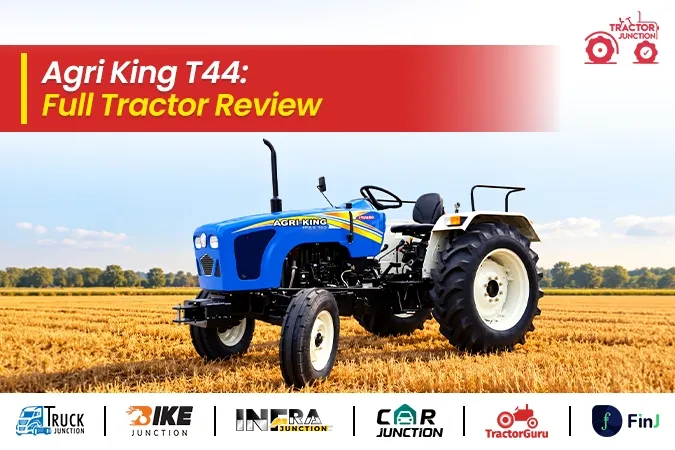 October 20, 2026
The Agri King T44 is a 39 HP tractor powered by a 3-cylinder Kirloskar engine.
Read More October 26, 2026
Are you looking for a tractor for regular farming activities such as ploughing, cultivation, rotavating
Read More October 12, 2026
Working in the field for eight or ten hours under the hot sun can be
Read More October 28, 2026
Buying a tractor is an important investment for any farmer. The right tractor should meet
Read More November 04, 2026
कहां से करें इन गुड कंडीशन वाले पुराने ट्रैक्टर की खरीद, जानें इसके फीचर्स और
Read More November 04, 2026
47 लाख से अधिक किसानों को मिलेगा फायदा, गन्ने के दाम बढ़ाने की मांग पर
Read More November 04, 2026
जानें, DBW 303, WH 1270 समेत 5 उन्नत किस्मों की विशेषताएं देश के कई राज्यों
Read More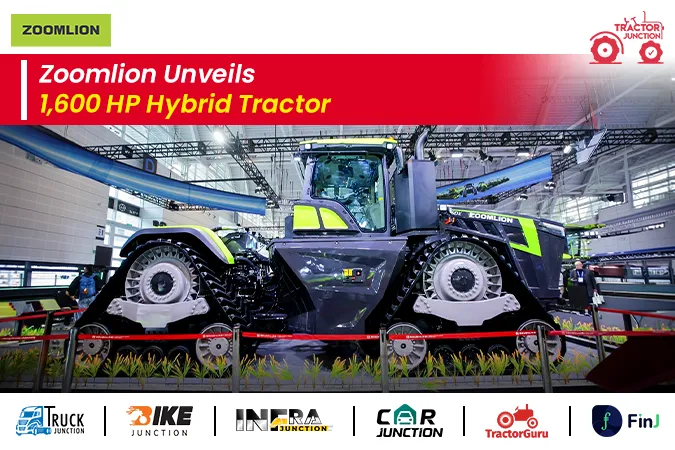 November 03, 2026
Chinese agricultural equipment manufacturer Zoomlion has claimed the title of building the world’s most powerful
Read More November 03, 2026
जानें बिना खेत के हाइड्रोपोनिक चारा उगाने और अजोला उत्पादन का तरीका, पशुपालक कम लागत
Read MoreIn Other News