Tractor Battery Draining Quickly Reasons and Quick Checks to Prevent Damage
 Published - 15 Oct 2026
by Sakshi Yadav

 Share
Social Share


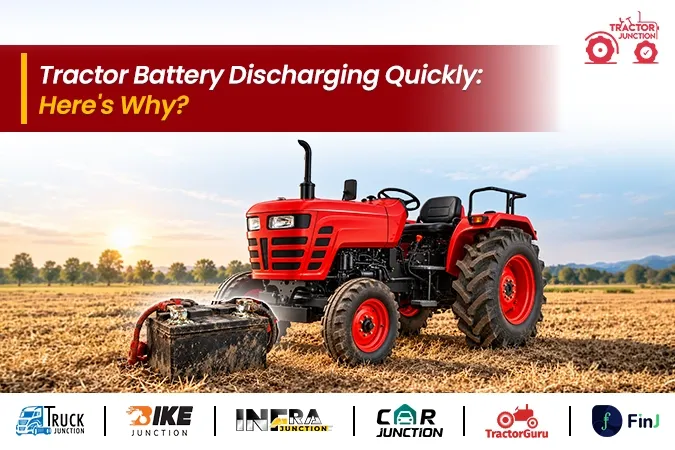
You charge your tractor battery, use the tractor for a day or two, and then one morning, it simply won’t start. Charging it again may get you back to work, but when the same problem returns, something is clearly wrong. A hidden power drain, charging system issue, loose wiring or even a light left on overnight can slowly drain the battery.
If you keep ignoring the cause, repeated charging can waste both time and money and delay important farm work. The good part is that most causes are easy to check. So, let’s look at the common reasons behind a fast-draining tractor battery and what you can do about each one.
Common Reasons Behind Fast Battery Drain
1. Loose or Corroded Battery Terminals
Popular Tractors



Look at your terminals closely. Is there a white or greenish crust on them? That's corrosion, and it blocks the power from flowing properly. If the clamps are loose as well, the battery struggles to charge at all.
Clean the terminals with a wire brush and a mix of baking soda and water. Then tighten the clamps firmly. Do this once a week, and it will save you a lot of trouble down the line.
2. Old or Worn Out Battery
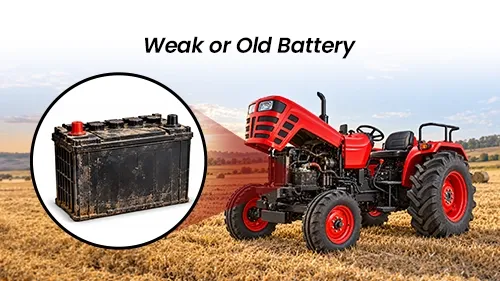
A battery doesn't last forever. Most give you two to three good years, and after that, charging won't bring back the strength it used to have. Many farmers keep charging an old battery again and again without realising it has simply reached the end of its life.
If your battery has crossed that age and still drains fast after a full charge, it's probably time to replace it.
3. Alternator Not Charging Properly

The alternator charges the battery while the engine runs, so it needs to work right for the battery to stay healthy. If it's weak or faulty, the battery never gets a full charge no matter how long the tractor runs. That means it starts each day a bit weaker than the last.
A quick voltage test at a service center will tell you if the alternator is the problem. Worth checking if this sounds like what's happening to you.
4. Wiring That Pulls Power Even When the Tractor Is Off
Sometimes a damaged wire, or a light wired the wrong way, keeps drawing power even after the engine is switched off. You won't notice it during the day. You'll just find a dead battery the next morning.
If the battery drains even when the tractor sits unused, get a mechanic to check the wiring for a short circuit or a loose connection.
5. Leaving Lights or Switches On

This sounds simple, but it happens more than you'd think. A headlight or indicator left on after the engine is off can drain a battery in just a few hours.
Get into the habit of checking every switch before walking away from the tractor. It takes a few seconds and can save you from a dead battery in the morning.
6. Low Battery Water Level
Most tractor batteries need their water topped up now and then. If the level drops below the plates inside, the battery can't hold its charge the way it should, and it drains faster than normal.
Check the water level every couple of weeks, and more often when it's hot. Use distilled water only. Tap water can damage the cells over time.
7. Too Many Short Engine Runs
If you start the tractor, run it for a few minutes, and switch it off, over and over through the day, the alternator never gets enough time to charge the battery properly. Do this often, and the battery stays weak all the time.
Let the engine run for a longer stretch when you can. That gives the alternator a real chance to charge the battery fully.
8. Damaged Battery Cables

Cables carry power from the battery to the rest of the tractor. A crack, a cut, or a loose fitting can cause a slow power leak or a weak connection, and the battery ends up paying for it.
Check the cables now and then for damage, and replace them as soon as you spot a problem. Don't wait for a cable to fail completely.
9. Extreme Heat or Cold
Weather affects batteries more than most people realize. In heavy heat, the water inside evaporates faster. In heavy cold, the battery has to work harder to give the same power. Both wear it down quicker than usual.
During extreme weather, check the battery more often, and keep it clean and properly topped up so it can handle the extra strain.
10. Charging With the Wrong Charger
Not every charger suits every battery. Too much current, or too little, can slowly damage the cells inside, even with regular charging. Once that damage is done, the battery drains fast no matter how well you look after it afterward.
Match the charger to your battery's type and size. If you're not sure which one to use, ask your dealer before buying.
Final Word
A tractor battery doesn't fail without warning. Most of these problems build up slowly, and it usually comes down to something small, loose terminals, an old battery, a weak alternator, or a light left on by mistake. Keep an eye on these points, and you'll catch trouble before it catches you.
Check the terminals, water level, and cables every couple of weeks. Watch for signs like slow starting or dim lights, and get the alternator tested if the draining continues. A few minutes of checking now can save a lot of time, money, and trouble later on.
FAQs
1. Why does my tractor battery drain quickly?
A tractor battery may drain quickly due to loose or corroded terminals, an old battery, a faulty alternator, damaged wiring, lights left on, or frequent short engine runs. Checking these issues can help identify the cause.
2. How do I know if my tractor battery is weak?
Common signs of a weak tractor battery include slow engine cranking, dim headlights, difficulty starting the tractor, and a battery that loses its charge soon after charging. A battery load test can help confirm its condition.
3. How long does a tractor battery typically last?
A tractor battery typically lasts around 2–5 years, depending on its type, usage, maintenance, and operating conditions. Extreme temperatures and repeated deep discharges can shorten its lifespan.
4. Can a faulty alternator drain a tractor battery?
Yes. A faulty alternator may fail to recharge the battery properly while the engine runs. This can leave the battery undercharged and cause starting problems. A charging system test can help identify the issue.
5. Why does my tractor battery die when the tractor is not in use?
A tractor battery may lose charge while parked because of parasitic electrical drain, damaged wiring, a light left on, or an internally damaged battery.
6. How often should I check my tractor battery water level?
For serviceable lead-acid batteries, check the electrolyte level according to the manufacturer's recommendations, especially during hot weather. Top up with distilled water when needed.
Certified Used Tractors
 Book Now


Top News
 October 25, 2026
Choosing the right tractor depends on your farm size, soil type, implements, and budget. A
Read More October 20, 2026
The Agri King T44 is a 39 HP tractor powered by a 3-cylinder Kirloskar engine.
Read More October 26, 2026
Are you looking for a tractor for regular farming activities such as ploughing, cultivation, rotavating
Read More October 28, 2026
Buying a tractor is an important investment for any farmer. The right tractor should meet
Read More October 24, 2026
Choosing between two tractors with almost the same horsepower is not always easy. Eicher 551
Read More November 11, 2026
New Delhi: A farmer's next big decision may be guided not by instinct alone, but
Read More November 11, 2026
New Delhi: Indian agriculture is approaching a significant technological transition, according to Veejay Nakra, President
Read More November 11, 2026
मुख्यमंत्री की बड़ी घोषणा, डेयरी सोसायटियों के जरिए खरीदा जाएगा बकरी का दूध; पशुपालकों को
Read More November 11, 2026
गेहूं की बुआई से पहले जान लें अपने क्षेत्र के लिए उन्नत किस्में, सही बुआई
Read More November 11, 2026
12 एचपी से लेकर 28 एचपी तक के विकल्प मिलते हैं, जिनमें 2WD और 4WD
Read MoreIn Other News