2-Year vs 6-Year Tractor Warranty: What Does it Mean for a Farmer?
 Published - 23 Jul 2026
by Sakshi Yadav

 Share
Social Share


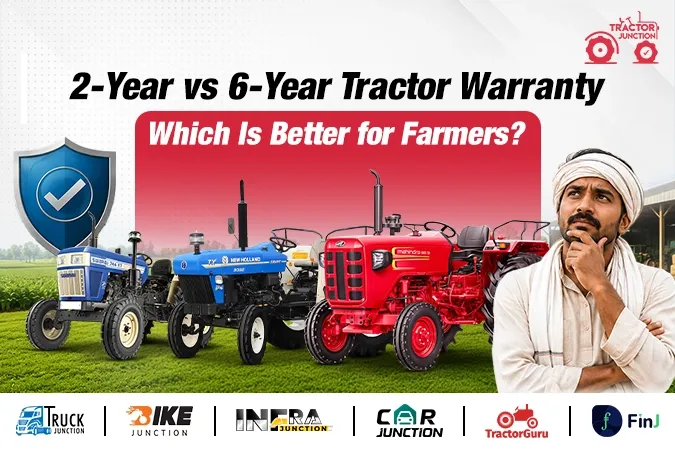
A tractor is a big investment, and major repairs can be hard on a farmer's budget, especially when EMI payments are still ongoing. An engine or transmission failure can lead to high repair costs and work delays during important farming seasons. That is why warranty coverage matters. A longer warranty helps protect farmers from unexpected repair expenses and gives more confidence during ownership.
With a 6-year warranty, farmers get:
- Longer protection against major repairs
- Lower risk of sudden expenses
- Better control over ownership costs
- More value from their tractor investment
This is why many farmers now consider warranty coverage before buying a tractor. Let's look at how a 2-year and a 6-year warranty differ and what that means for your long-term costs.
Popular Tractors


What is a Tractor Warranty?
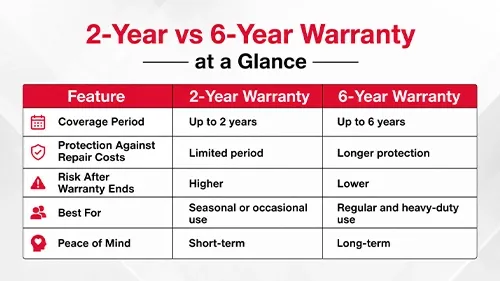
A tractor warranty is a promise from the company. It says: "If something breaks because of our fault, we will fix it for free within this time period." Most standard warranties in India cover 2 years or 2,000 hours, whichever comes first. This "whichever comes first" part matters.
If you use the tractor heavily and clock 2,000 hours in just 14 months, your warranty ends at 14 months, not 2 years. Extended warranties can go up to 5 or 6 years, giving you much longer protection on all major parts.
2-Year vs 6-Year: Side by Side
| Factor | 2-Year Warranty | 6-Year Warranty |
|---|---|---|
| Duration of cover | 2 years or 2,000 hours | Up to 6 years |
| Repair risk | High after year 2 | Low for much longer |
| Best for | Light or seasonal use | Daily heavy farm use |
| Resale value | Lower | Higher |
| Budget planning | Unpredictable costs | More predictable |
| Who benefits most | Part-time farmers | Full-time farmers |
What Does a 2-Year Warranty Cover?
A standard 2-year warranty typically covers engine parts, gearbox and transmission, hydraulic system, and electrical system faults caused by manufacturing defects. It does NOT cover wear and tear parts like tyres, filters, belts, and clutch plates. It also does not cover damage from wrong use, overloading, or missed services.
The real problem with 2 years is this: the first 2 years are usually the safest for any new machine. Parts are fresh, and the tractor runs well. Gaskets start leaking, bearings make noise, and hydraulic seals weaken. These are the years when repair costs start climbing, and these are exactly the years a 2-year warranty leaves you unprotected.
What Does a 6-Year Warranty Give You?
A 6-year warranty gives you the same cover but for a much longer period. If a major part fails in year 4, the company still pays for it. You are not running to a dealer with your own money during a busy crop season.
Here is what that means in real money. Common repairs and their approximate costs without warranty:
- Hydraulic pump failure: Rs. 20,000 to Rs. 45,000
- Gearbox repair: Rs. 30,000 to Rs. 70,000
- Engine overhaul (partial): Rs. 40,000 to Rs. 1,00,000
- Fuel injection pump repair: Rs. 15,000 to Rs. 35,000
Any one of these in year 3 or 4 costs more than most extended warranty plans. Two in the same year would be a serious setback for most farming families. Even if the extended warranty costs Rs. 10,000 to Rs. 20,000 extra at the time of purchase, a single major repair easily recovers that amount.
Why Do Some Warranty Claims Get Rejected?
Many farmers lose their warranty without realizing it. Companies require you to follow a scheduled service plan to keep the warranty valid, usually every 250 to 500 hours at an authorized center.
If you skip even one service, the company can reject your warranty claim. They will say the damage happened because the tractor was not maintained properly. You will have no way to argue.
What many farmers do is get the first 2 to 3 services done at the dealer and then switch to a local mechanic. This is a costly mistake when you have an extended warranty. Always get services done at an authorised centre and collect the service stamp every single time.
Should You Go for an Extended Warranty?
Go for it if you use the tractor every day, run it for multiple tasks like tilling, sowing, and transport, have a loan running, or plan to use it for more than 4 years. It is also worth it if you want a higher resale price when you sell.
You may skip it if you use the tractor only 2 to 3 months a year or for very light work with low hourly use.
Final Word
A 2-year warranty covers the safest years of a tractor's life. A 6-year warranty covers the years when real problems actually start showing up.
For a farmer whose income depends on the tractor running well, that extra cover is not just a number on a paper. It is money saved when the hydraulics fail before harvest. It is stress avoided when the gearbox needs work during sowing season. It is the difference between a repair that costs you nothing and one that costs you two months of farm income.
Before you sign any tractor deal, ask your dealer one simple question: "What happens if something breaks in year 4?" How they answer that question should guide your decision.
FAQs
1. What is the difference between a 2-year and a 6-year tractor warranty?
A 2-year warranty covers the tractor for a shorter period, while a 6-year warranty extends protection against manufacturing defects for several additional years, reducing the risk of unexpected repair expenses.
2. What parts are usually covered under a tractor warranty?
Most tractor warranties cover major components such as the engine, transmission, gearbox, hydraulics, and certain electrical systems against manufacturing defects.
3. Does a tractor warranty cover tyres, clutch plates, and filters?
No. Wear-and-tear items such as tyres, filters, belts, brake linings, and clutch plates are generally not covered under warranty.
4. Is an extended tractor warranty worth buying?
An extended warranty can be useful for farmers who use their tractor regularly, have a loan running, or plan to keep the tractor for many years.
5. Can a warranty claim be rejected?
Yes. Warranty claims may be rejected if scheduled services are skipped, unauthorized repairs are carried out, or the tractor is used against the manufacturer's guidelines.
6. Does warranty coverage increase a tractor's resale value?
Yes. A tractor with an active warranty is often more attractive to buyers and may fetch a better resale price than a tractor without warranty coverage.
7. How can farmers keep their tractor warranty valid?
Farmers should follow the recommended service schedule, use authorized service centers, and maintain proper service records and warranty documents.
Certified Used Tractors
 Book Now



Top News
 November 12, 2026
Swaraj 855 FE 4WD and Mahindra Arjun Novo 605 DI-i 4WD are two well known
Read More November 14, 2026
Farming costs keep going up. Diesel, inputs and equipment all cost more every year. For
Read More November 01, 2026
Choosing the right tractor is one of the biggest decisions a farmer makes, because the
Read More October 30, 2026
Farming does not wait for machines that break down or feel hard to handle. You
Read More November 03, 2026
Choosing the right tractor depends on your farm size, daily workload, budget, and the implements
Read More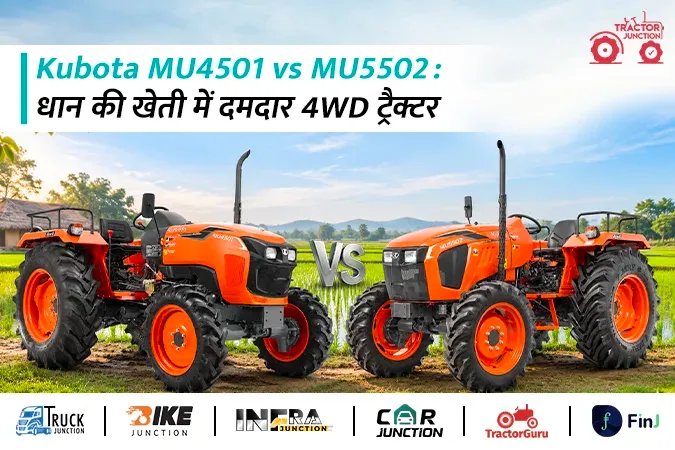 November 28, 2026
45 HP और 55 HP की दमदार श्रेणी वाले दोनों ट्रैक्टरों में इंजन, गियरबॉक्स, हाइड्रोलिक
Read More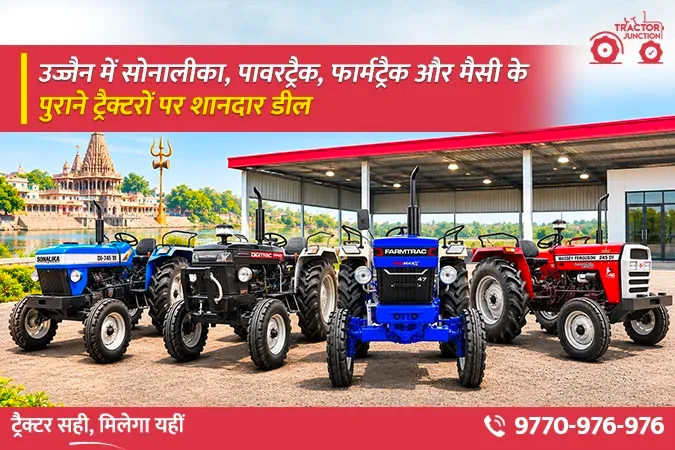 November 28, 2026
जानिए प्रमुख मॉडल, उनकी कीमत और ट्रैक्टर जंक्शन से पुराना ट्रैक्टर खरीदने के फायदे खेती
Read More November 28, 2026
मुख्यमंत्री ने गन्ने का राज्य परामर्शित मूल्य (SAP) बढ़ाकर 431 रुपये प्रति क्विंटल करने का
Read More November 27, 2026
Nagpur, November 27, 2026: Mahindra Tractors, part of Mahindra's Farm Equipment Business, showed its Ethanol
Read More November 27, 2026
एक सप्ताह में गुलाब बाग मंडी में मक्का का भाव 130 रुपये प्रति क्विंटल टूटा,
Read MoreIn Other News